What Is a Waxing Crescent Moon?
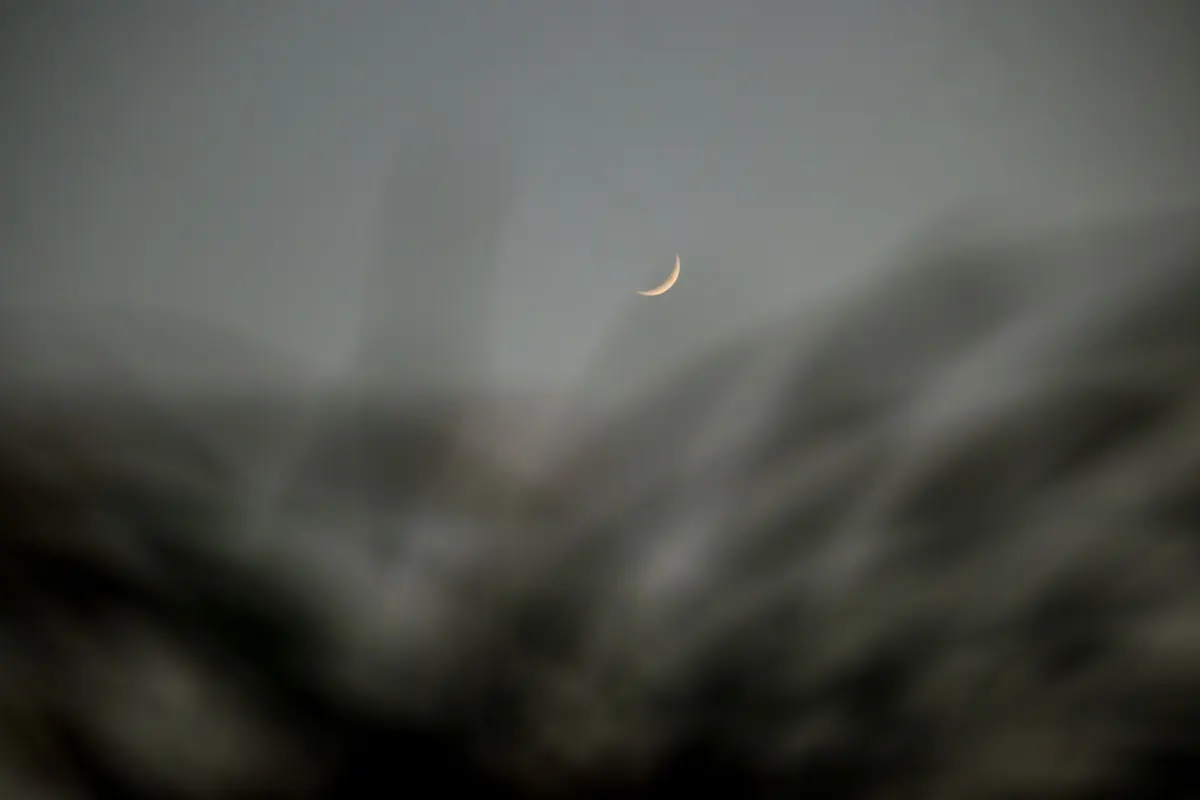
Twenty minutes after sunset on the third evening of a lunar month, look west. If the horizon is clear, a thin bright sliver will be hanging there, tipped toward the spot where the Sun went down. That is a waxing crescent: the Moon on its way back to full, and the first phase most people can catch with the naked eye. It is also the phase with the shortest patience requirement, often giving you barely an hour of useful viewing before it follows the Sun below the horizon.
What "Waxing" Actually Means
At new moon, the Moon sits between Earth and the Sun, and its sunlit half faces away from us. As it travels eastward along its orbit, a sliver of that lit face rotates into view. Waxing means growing: the illuminated fraction increases night by night, from a hairline curve to the half-lit disk of first quarter.
The numbers move faster than you might expect. A Moon one day old is often only about 1 percent lit; at two days it is roughly 5 percent; at three days, about 10 percent. It reaches first quarter, half lit, about seven days after new moon. Everything between that first sliver and first quarter counts as a waxing crescent, which is why the name covers such a wide range of looks, from a near-invisible thread to a fat, obvious curve.
Where and When to Look
Always west or southwest, always after sunset, always lower than you expect. The crescent stays close to the Sun in the sky, trailing it across the day and following it down. On the first evening it is visible, it may sit only a few degrees above the horizon at sunset.
- Find your sunset point before the Sun disappears, then keep watching that patch of sky.
- Start at sunset, not at full darkness. Twilight still hides faint stars, but it does not hide the crescent.
- Sweep the area with binoculars if the sliver is not obvious. They turn a marginal sighting into an easy one.
- Look for the horns. The bright limb faces the Sun, so the two points of the crescent aim away from the sunset glow, up and to the left in the Northern Hemisphere.
Within a night or two the pattern becomes unmistakable: the crescent sits higher, leans further from the sunset point, and stays up longer.
How Long a Waxing Crescent Lasts
Two different answers, and both matter.
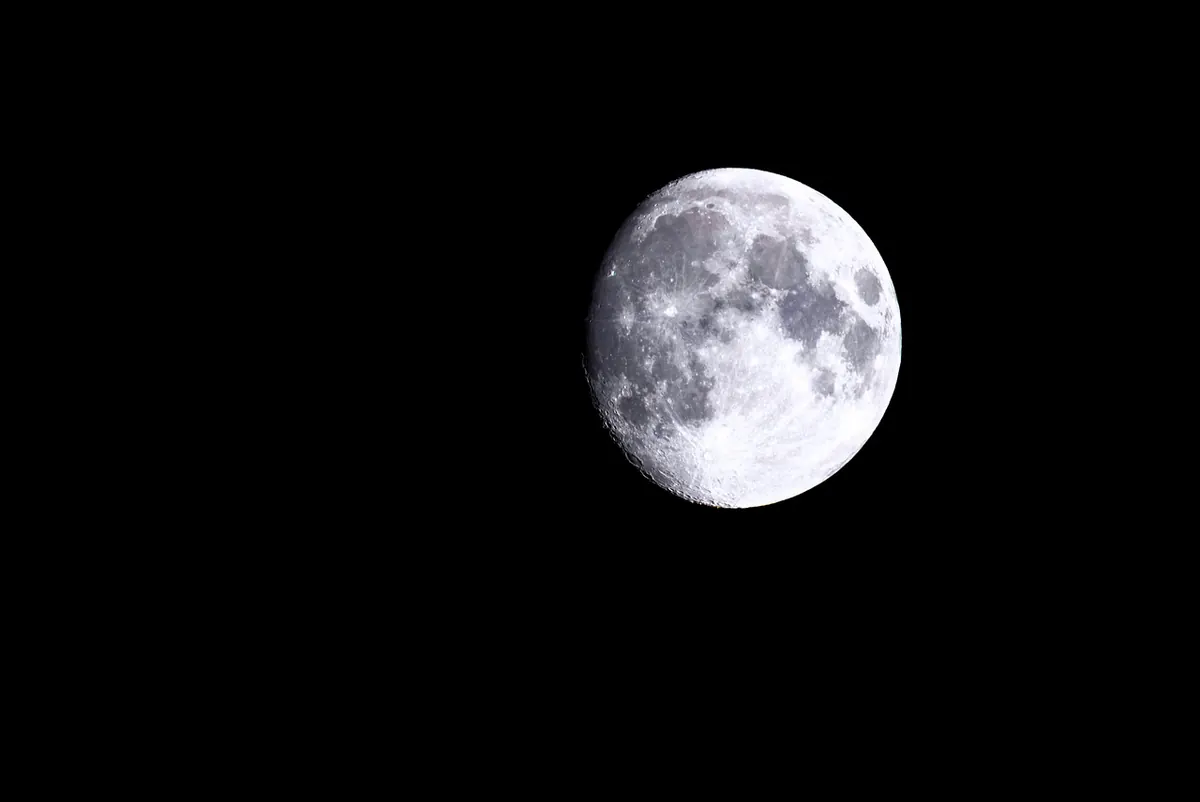
The phase itself lasts roughly seven days, from the first appearance after new moon until first quarter. After that the Moon is a waxing gibbous.
Any single night's window is much shorter. As a rough rule, the Moon sets about four minutes later for every degree it lies east of the Sun. Right after new moon the separation is only about 12 degrees, so the crescent follows the Sun down within roughly three-quarters of an hour. At two days, with about 25 degrees of separation, you get closer to an hour and a half. At three days, near two hours. Toward first quarter the Moon is 90 degrees from the Sun and sets around local midnight.
The practical version: expect a narrow 30-to-60-minute window in the first days, then a comfortable two or three hours by the fifth or sixth night. The Moon also rises and sets roughly 50 minutes later each day on average, which is why the crescent shifts from nearly impossible to unmissable in under a week.
Why It Sets So Soon After Sunset
The Moon does not race across the sky. Earth's rotation carries everything westward at the same rate, 15 degrees per hour, or one degree every four minutes. What changes from night to night is where the Moon sits along the Sun's path.
Every degree of separation from the Sun buys roughly four more minutes above the horizon after sunset.
During the crescent phase the Moon is only 12 to 45 degrees east of the Sun. Sunset happens when the Sun reaches the western horizon, and the Moon, sitting a short way ahead of it along the same path, arrives there a short time later. Fifteen degrees of separation equals about an hour; 12 degrees equals about 50 minutes. Compare that with full moon, which sits opposite the Sun and therefore rises as the Sun sets, giving you the whole night.
Why Some Crescents Linger Longer
The angle between the Moon's path and the horizon is not fixed. It changes with your latitude and the season, and that angle decides how high the crescent sits for a given distance from the Sun.
In the Northern Hemisphere, evening crescents do best in spring. From roughly February through April, the path the Sun and Moon follow meets the western horizon at a steep angle, so a young Moon 20 degrees from the Sun may sit noticeably above the haze. On autumn evenings that same geometry goes flat, and a crescent of the same age can hover just a few degrees above the horizon, lost in the glow. Southern Hemisphere observers get the reverse, with their best evening crescents in their own autumn.
Latitude matters too. The further you live from the equator, the more extreme the tilt becomes in both directions. The tilt also changes the crescent's apparent shape: when the path is steep it can look like a shallow bowl or a smile, and when it is flat it looks more like a tilted C or a comma. Same Moon, different geometry.
Waxing or Waning? A Quick Check
Two questions settle it every time. Is the crescent in the evening sky or the morning sky? Evening means waxing, morning means waning. Which side is lit? In the Northern Hemisphere, a waxing crescent is bright on the right as you face it, a waning crescent on the left; south of the equator that is reversed.
The deeper rule works everywhere: the Moon's lit side always faces the Sun. A crescent points, roughly, at the Sun's position below the horizon. And a waxing crescent grows thicker from night to night, while a waning one thins.
Practical Tips for a First Sighting
- Choose a genuinely open western horizon: a hilltop, a beach, a long flat field. A treeline will cost you the first half hour, which is exactly when the crescent is visible.
- Check the Moon's age and set time before you go out. A planetarium app or an almanac gives you both. Under about 24 hours old, the crescent is a real challenge.
- Arrive before sunset and note landmarks, such as a mast or a particular roof, so you can return your gaze to the right patch of sky as it darkens.
- Use twilight rather than full darkness. A thin crescent stands out better against a blue sky than against black, where stars compete for your attention.
- Once you have found it, look through binoculars for earthshine, the faint glow on the unlit part of the disk, caused by sunlight reflected off Earth's clouds and oceans.
- Come back the next evening. The window is longer, the crescent is brighter, and you already know where to look.
A crescent can also be spotted in daylight, with the Moon above the horizon while the Sun is still up. That is a more advanced pursuit: keep the Sun safely outside the field of view of any binoculars or telescope, or stay behind a building that blocks it completely.
Watch One Crescent Grow
Pick a lunar month and go out six evenings in a row at the same time, say half an hour after sunset. The first night you may see nothing, or only a thread you have to squint for. By the fifth or sixth night you will be looking at a wide, bright curve standing high in the southwest, still up two hours after the Sun went down. Note the clock time and the direction each evening. The same Moon returns as a thinning crescent in the morning sky about two weeks later, and by then you will know exactly how to find it.
Photo: Myriams-Fotos / Pixabay
How to Plan a Moonlit Landscape Photography Session
Plan a moonlit landscape shoot by choosing the right phase, timing the moonrise, dialing in exposure, and...
Sidereal vs Synodic Month: Why Lunar Calendars Drift
The Moon returns to the same stars every 27.32 days, but its phases take 29.53 days. That 2.2-day gap...